
International Women’s Day (IWD), observed on March 8, originated in the early 20th century as a call for gender equality and women’s rights. The first significant observance was in 1911, initiated by Clara Zetkin, from Germany highlighting women’s struggles for suffrage, better working conditions, and equal rights.
In1917,Russian women protesting during World War-I played a key role in the Russian Revolution, making March 8 a national holiday in the Soviet Union. In 1975, the UN officially recognized International Women’s Day. Today, it serves as a global call to action, emphasizing the need for continued progress in achieving gender parity.
In India, International Women’s Day holds significant importance as it provides an opportunity to reflect on the progress made in women’s empowerment and the challenges that remain. Despite India’s rich cultural history of female strength, society still grapples with deeply rooted patriarchal structures and gender biases.
Indian women continue to face challenges related to education, healthcare, safety and employment opportunities. Violence against women, including domestic abuse, trafficking and sexual harassment, remains a pressing issue, demanding not just societal change but also stronger policy reform and law enforcement.
Celebrating International Women’s Day in India acknowledges the resilience and contributions of remarkable women such as Sarojini Naidu, Indira Gandhi, Kalpana Chawla and Mithali Raj, who have made significant marks in politics, space exploration, and cricket.
International Women’s Day is a day for men and women alike to come together to discuss gender equality and recognize the transformative power of women, advocating for the societal change and support needed to continue their advancement.
Also Read: Entrepreneurial Ambition Among Indian Women Rises to 64%, ACCA Survey Finds
Importance of Women in Any Society : From Past to Present.
From time immemorial, women have been the backbone of every society across the globe. Historically, their roles were confined largely to domestic duties, nurturing families and ensuring cultural continuity. Yet, even in these limited roles, women were pivotal in shaping the social and cultural fabric of every community. In ancient civilizations, women were revered as goddesses, wise sages and influential queens, exemplifying the high regard they held in various societies.
In India, from the regal influence of Queen Victoria in the colonial era to the heroic endeavors of figures like Rani Lakshmibai of Jhansi during the 1857 rebellion, women have been an indelible force in shaping the country’s history.
Women in the past often had limited agency, but their contributions were still immensely impactful, whether in war, governance, or social transformation. They were the unsung heroines who led movements, initiated revolutions and nurtured a sense of unity and community.
Fast forward to the present day and women is no longer confined to these historical roles. Today, they are key decision-makers, political leaders, entrepreneurs, scientists and artists. Their involvement has significantly shaped global economies, cultures and political landscapes.
The importance of women in contemporary society is irrefutable, as they contribute not only to the economy but also to cultural innovation, technology, healthcare and environmental sustainability.
In India, women now serve in the highest echelons of government, corporate sectors, and defense forces. They hold positions as CEOs, judges, scientists, soldiers and politicians. Women have shown time and again that they are central to the progress and growth of society, regardless of challenges and adversities.
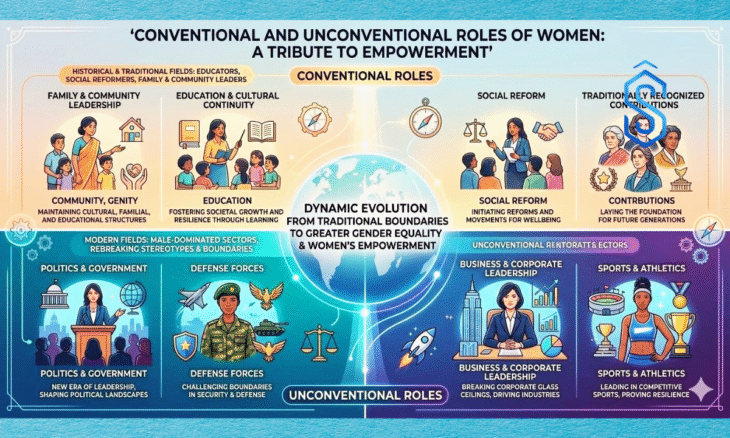
Conventional and Unconventional Roles of Women: A Tribute to Empowerment
Throughout history, women have faced societal expectations and limitations on the roles they can occupy. However, overtime, these roles have expanded significantly as women have actively worked to challenge the boundaries that have traditionally restricted them.
Today, women not only play vital roles in conventional spaces like family, education, and social reform, but they have also carved their place in fields once dominated by men, proving their resilience and versatility. This dynamic evolution from conventional roles to unconventional spaces has shaped the path for greater gender equality and women’s empowerment across the globe.
Also Read: Kalaari CXXO Report: Women Founders Get Just ₹4 of Every ₹100 Raised in India’s Startup Networks
Conventional Roles
Women have historically played significant roles in maintaining cultural, familial, and educational structures, providing the foundation for societal growth and resilience. In this section, we highlight women who have made contributions.
Through traditionally recognized and conventional roles, often as educators, social reformers, and leaders of family and community.
- Savitribai Phule: A pioneer in women’s education, she opened the first girls’ school in Pune in 1848, creating a platform for women’s empowerment through education.
- Pandita Ramabai: Asocial reformer who founded the Arya Mahila Samaj, dedicated to improving women’s rights, particularly focusing on widows and women’s education.
- Rajmata Jijabai: Mother of Chhatrapati Shivaji Maharaj, she was a visionary strategist who played a key role in shaping the administration and ideology of Swarajya, nurturing the values of leadership in her son.
- Ahilyabai Holkar: Known for her exceptional administration, Ahilyabai Holkar’s justice-focused reign is celebrated for its contribution to peace, religious tolerance, and temple reconstruction in the Maratha Malwa kingdom.
- Pratibha Patil: The 12th PresidentofIndia, Pratibha Patil became the first woman to hold the office of the President, showcasing leadership and breaking gender barriers in politics. Her tenure brought attention to social welfare, rural development, and women’s empowerment.
These women upheld family values, education, and social reform, contributing to the nation’s growth through conventional roles such as educators, advisors, and administrators.
Unconventional Roles
In today’s world, women have increasingly taken on roles that challenge traditional boundaries, breaking stereotypes in male-dominated fields. These women represent a new era of leadership in politics, defense, sports, and business, shaping industries and sectors with their groundbreaking achievements.
- Indira Gandhi: India’s first female Prime Minister, Indira Gandhi played a central role in shaping modern India’s political and economic landscape. Her leadership during critical moments like the 1971 war and the Emergency era set her apart as one of the most powerful figures in Indian politics.
- Sushma Swaraj: India’s first woman External Affairs Minister, known for her deft diplomacy and leadership. She became a prominent figure on the international stage, negotiating with foreign leaders and ensuring the safety of Indian citizens abroad.
- Mithali Raj: AlegendarycricketerandformercaptainoftheIndianwomen’scricket team, Mithali Raj has shattered the glass ceiling in sports, serving as an icon for young women in cricket and leading India’s cricketing success internationally.
- Dr. Tessy Thomas: Known as the ‘Missile Woman of India,’ Dr. Tessy Thomas made significant contributions to India’s defense sector, working as a key figure in the development of the Agni missile, and showcasing how women are breaking barriers in military and defense technology.
- Kiran Bedi: The first woman officer in the Indian Police Service, Kiran Bedi’s career in law enforcement and her reformative approach in the prison system have set her apart as a pioneer for women in civil services.
- Wing Commander Shaliza Dhami: The first woman officer in the Indian Air Force assigned to a combat role, Wing Commander Dhami has paved the way for women in the armed forces, demonstrating resilience and leadership.
- Dr. Kiran Mazumdar-Shaw: As the founder of Biocon, Dr. Mazumdar-Shaw has revolutionized the biotechnology industry in India. Her leadership in the biotech sector has set a global precedent, particularly for women in business and science.
Impact and the Way Ahead: International Women’s Day in 2026
As we look toward 2026, the impact of International Women’s Day celebrations and the broader global conversation on women’s rights continues to evolve. What began as a day to highlight the struggles of women has now become a platform for advocating for equal rights, creating more inclusive work environments and ensuring that women have a seat at the table in decision-making processes.
For India, the future of International Women’s Day celebrations hinges on several critical aspects. Firstly, ensuring the education and empowerment of women from the grassroots level is essential. The Indian government’s schemes like Beti Bachao Beti Padhao and Pradhan Mantri Ujjwala Yojana are crucial steps in providing women with the tools they need to succeed.
These initiatives must be expanded to reach rural and underserved areas where the impact is minimal. Women’s participation in politics, technology and business must be actively encouraged to create a more gender-inclusive society.
In 2026, it is likely that International Women’s Day will serve as a significant reflection on the achievements of women in diverse fields such as sports, technology and governance. The next decade will also see a growing conversation around mental health, work-life balance and the need for support systems for women in the workforce. This includes addressing challenges such as unequal pay, career progression obstacles and workplace harassment.
The focus will also be on digital empowerment for women, enabling them to access opportunities in the rapidly growing tech industry. With initiatives like Digital India, it is imperative to ensure that women are not left behind in the digital revolution. Training and empowering women in IT, coding and entrepreneurship will be a major focus in the years ahead.
In terms of policy, India will need to see continued progress on laws that protect women, especially from violence. Stronger enforcement of existing laws, more women-friendly workplaces and better healthcare options for women are all areas in need of attention.
International Women’s Day is more than just a celebration; it is a call to action. It is a day to recognize the immense contributions women have made and continue to make in every field of life.
From traditional roles to breaking barriers in unconventional fields, women’s impact on society is irreplaceable. The fight for gender equality, however, is not over and we must keep pushing forward to create a world where women are empowered, equal and free from the shackles of gender-based discrimination.
This International Women’s Day 2026, let us renew our commitment to the advancement of women’s rights, to creating spaces where women can thrive and to building a society where gender equality is not a dream but a reality.
On this International Women’s Day, let us honor the women of today and the women of tomorrow.